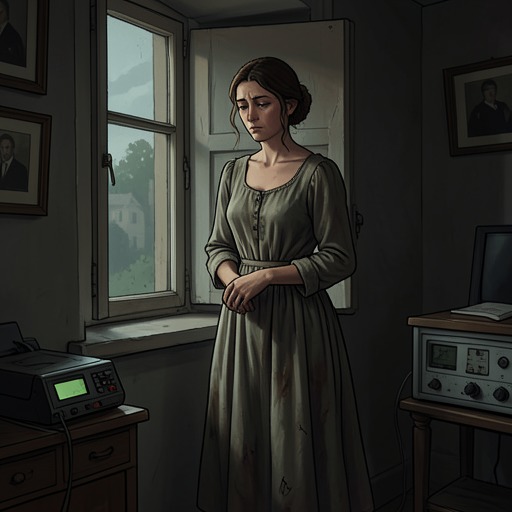
Mrs. Douglas
Anne of the IslandMrs. Douglas is John Douglas’s mother, a woman whose long illness keeps her son close to home and whose request, made nineteen years before her death, prevents him from proposing to Janet Sweet. At first she seems to welcome Janet as the wife she hopes John will choose; only after her death does the history behind their postponed marriage become clear. The contrast between her gracious welcome and the promise she had required from her son makes her a quiet but decisive force in their courtship.
Identity and First Appearance
Mrs. Douglas receives Janet and Anne Shirley at the Douglas homestead, where John meets them at the door and brings them into the sitting room. Anne has expected a tall, thin woman, but instead finds a small, delicately dressed figure, with pink cheeks, blue eyes, white hair, a lace cap, and a white shawl over a black silk dress. Her appearance gives the first impression of someone gentle and dependent, an impression reinforced by her affectionate greeting to Janet.
She addresses Janet warmly and welcomes Anne as the new teacher. She says John has praised Anne so much that she is almost jealous, then teases that Janet ought to be jealous too. The remark makes the direction of her apparent hopes plain: she presents Janet as a likely match for her son. Janet blushes and is visibly uncomfortable, while John sits without smiling. That difference in their responses complicates the friendliness of the scene before Anne yet understands why John seems so ill at ease.
A Welcome Shadowed by Illness
During the visit, Mrs. Douglas keeps Janet beside her, strokes her hand, and asks her to pour the tea. Afterward she sends John and Janet into the garden to gather roses, while asking Anne to remain with her. The arrangement leaves Mrs. Douglas alone with Anne and gives the visit a more intimate turn: she describes herself as having suffered for more than twenty years and speaks as if her death is near.
She tells Anne that John is her only son and that his happiness matters deeply to her. She praises Janet’s character and housekeeping, and says she is thankful John has chosen someone who can look after him after his mother is gone. She also explains that her own health prevented her from managing a household. These remarks make her approval appear wholehearted, even protective. Yet John’s strained expression during the visit, and Anne’s uncertainty about it, leave a gap between Mrs. Douglas’s reassuring words and the atmosphere around her son.
The illness is not merely a private complaint: Janet later says it makes John anxious to leave home in case his mother has an episode while only the hired girl is there. Mrs. Douglas’s dependence therefore shapes John’s daily choices as well as his prospects for marriage. Her account of a prolonged illness and her family’s expectation that she might die soon also helps explain why the promise she demanded could initially have seemed temporary. The doctor had given her only six months during the episode when she asked for it; instead, she lived for many more years.
The Promise Behind the Courtship
After Mrs. Douglas dies, Janet tells Anne that her last conversation with the older woman included a question about whether Janet would marry John now. Janet is hurt that Mrs. Douglas had apparently believed she might refuse him because of his mother. At that moment, she does not explain the history behind the question; she is grieving, and there are other people present. The question nevertheless brings the concealed impediment to the surface.
John later explains that, nineteen years earlier, during a severe illness, his mother had asked him not to propose to Janet while she was alive. He says she did not object to Janet in particular; she did not want another woman in the household during her lifetime. Though the doctor expected Mrs. Douglas to live only six months, John made the promise when she pleaded with him, and she continued to hold him to it. He had repeatedly asked her to release him, but the promise remained in force until her death.
This revelation reinterprets the earlier visit. Mrs. Douglas’s praise of Janet and her suggestion that John would bring her to stay could sound like an invitation to the marriage she had long prevented. The account does not erase the sincerity of her stated concern for John’s happiness, but it establishes that her wishes and her conduct had kept him from acting on that happiness. Her public warmth and private demand coexist, leaving John and Janet to bear the delay.
Death and Consequences
Mrs. Douglas dies soon after Janet arrives at the house. Her final question to Janet makes the approaching change explicit, but the larger consequence emerges only when John discloses the old promise. With his mother gone, he is free to propose; Janet accepts, and the two plan a quiet marriage for the following month. She chooses not to disclose the reason for the delay, asking John to let the truth remain between them rather than cast a shadow on his mother’s memory. Her decision preserves Mrs. Douglas’s reputation in public even as the private history finally becomes known to Anne.
Mrs. Douglas’s role is therefore defined less by the length of her appearances than by the duration of her influence. Her illness keeps John near her, and her request binds his courtship for nearly two decades. At the same time, her affectionate treatment of Janet and her expressed hope for John’s future make her more than a simple obstacle: the story places her care for her son alongside a demand that limits his freedom. Her death ends that constraint, while Janet’s choice to forgive and keep the explanation private determines how its legacy will be remembered.